Share Posts




46

651
103
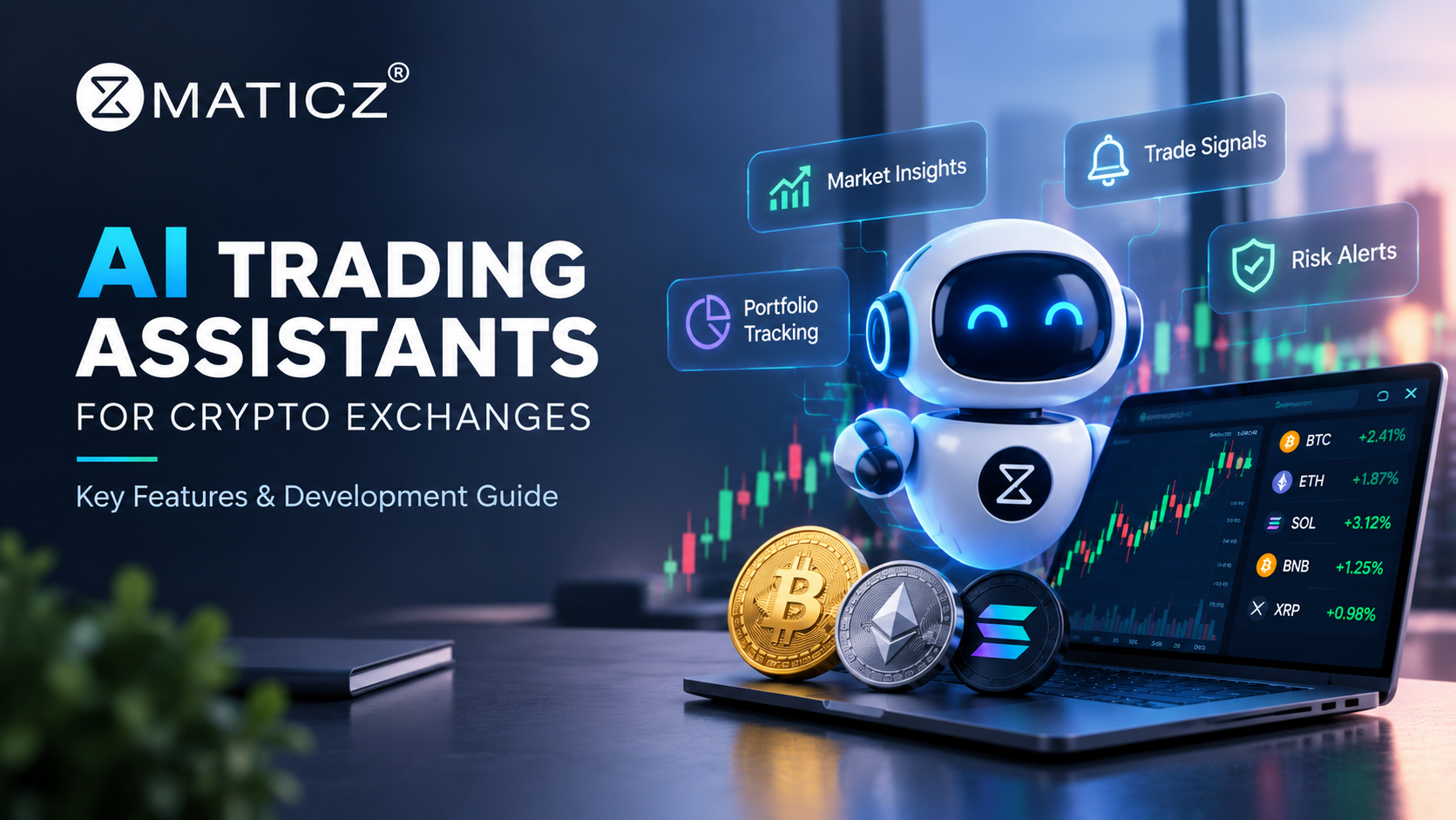
Crypto exchanges are no longer competing only on listed assets or trading fees. Traders now expect faster market insights, smarter portfolio tools, better risk controls, and smoother ways to act on market opportunities.
This is where AI trading assistants are becoming an important addition to modern crypto platforms.
An AI trading assistant can monitor market data, identify trading patterns, analyze portfolio conditions, generate trading signals, and help users execute strategies based on predefined rules. For exchange businesses, these capabilities can improve the trading experience while creating opportunities for user engagement, premium features, and trading activity.
For founders planning Cryptocurrency Exchange Development, adding AI capabilities can create a more differentiated product. Instead of building another exchange with standard order books and wallets, businesses can create an intelligent trading environment that helps users make faster and more informed decisions.
This guide explains AI trading assistants, essential features, technology considerations, the Cryptocurrency Exchange Development Process, and the factors influencing the cost of building an AI-enabled crypto exchange.
Crypto markets operate continuously. Prices can move sharply within minutes, liquidity can change across trading pairs, and opportunities can appear across multiple exchanges.
A human trader cannot continuously monitor every market, trading pair, portfolio position, and risk signal. An AI trading assistant can process large amounts of market information and present useful insights at the right time.
For exchange owners, this creates value on two levels: traders receive a more intelligent platform experience, while exchanges can introduce advanced services that encourage users to remain active.
An AI assistant can monitor price movements, trading volume, order-book activity, volatility, funding rates, liquidity, and other market indicators in real time.
Instead of manually checking multiple charts, users can receive important changes and trading conditions that match their preferences.
For example, an assistant could notify a trader when:
A selected asset experiences an unusual volume increase.
A predefined price level is reached.
Market volatility crosses a specific threshold.
A portfolio becomes overexposed to one asset.
A potential arbitrage opportunity appears.
This automation is especially useful for professional traders managing multiple positions.
AI trading assistants can work with predefined trading rules and automated strategies. Users can configure conditions for buying, selling, portfolio rebalancing, or risk management.
The assistant does not necessarily need unrestricted trading authority. A safer approach is to combine AI-generated recommendations with user-defined rules, risk limits, and execution permissions. This gives exchange businesses greater control over automated trading.
Risk management is an important area where AI can add practical value.
The assistant can evaluate portfolio exposure, volatility, position size, leverage, drawdown, and other risk indicators. When a portfolio moves outside predefined limits, the system can alert the user or trigger an approved risk-management action.
For exchanges supporting derivatives, margin trading, futures, or options, intelligent risk monitoring becomes even more important. AI can support existing risk engines but should not replace deterministic controls such as margin calculations, liquidation rules, transaction validation, and compliance checks.
Different traders have different goals. Beginners may want simple market explanations and portfolio alerts, while experienced traders may want technical signals, arbitrage monitoring, or automated execution. Institutional users may require advanced analytics and configurable risk parameters.
An AI trading assistant can personalize the experience based on user preferences, trading history, portfolio composition, and selected strategies.
An AI trading assistant should not operate as an isolated chatbot. It should connect securely with market-data systems, trading engines, portfolio services, wallets, risk-management systems, and user-permission controls.
These are the major capabilities businesses should consider during Crypto Exchange Platform Development.
Real-time analytics form the foundation of an intelligent trading assistant. The system can collect data from internal order books and external market sources. AI models can analyze this information to identify patterns, unusual movements, market sentiment, and other signals.
A well-designed analytics module can provide:
Price and volume analysis
Volatility monitoring
Order-book analysis
Market sentiment indicators
Technical indicator analysis
Liquidity monitoring
Funding-rate analysis
Cross-market price comparisons
The important point is converting market data into information that traders can understand and act upon.
AI models can analyze historical and real-time data to generate probability-based trading signals.
For example, the assistant could identify conditions that historically preceded a certain type of price movement. The platform should communicate this as an analytical signal rather than a guaranteed prediction.
A trading assistant can display:
BTC/USDT — Potential bullish signal
Momentum: Strong
Volume: Above recent average
Volatility: Moderate
Signal confidence: Platform-defined score
Suggested action: Review buy strategy
The final trading decision can remain with the user unless automated execution has been explicitly enabled.
Crypto assets can trade at different prices across exchanges and liquidity pools.
An AI-powered arbitrage module can monitor multiple markets and identify potential price discrepancies after considering trading fees, slippage, network costs, and execution conditions. The assistant can notify users or execute predefined arbitrage strategies where permitted.
For an exchange operator, arbitrage functionality can become part of a broader professional trading toolkit.
Suppose a trader wants to maintain:
50% BTC
30% ETH
20% stablecoins
If market movements change the allocation significantly, the AI assistant can identify the deviation and recommend a rebalance. Users can choose whether the platform only provides recommendations or automatically executes approved rebalancing rules.
Users can interact with the exchange using natural language instead of searching through multiple menus.
For example:
“Show me the top-performing assets in my portfolio this week.”
“Set an alert if BTC falls below my selected price.”
“What is affecting ETH volatility right now?”
The assistant can interpret the request and connect it with the appropriate exchange function. For trade execution, confirmation steps and permission controls should be used before submitting an order. Natural-language input should never bypass authentication, trading limits, or security controls.
Users can receive alerts based on portfolios, watchlists, trading strategies, and risk preferences.
The assistant can monitor:
Asset price changes
Portfolio drawdown
Trading volume
Market volatility
Funding rates
Liquidation risk
Arbitrage spreads
Strategy conditions
Personalized alerts reduce the need to constantly monitor charts and can encourage more consistent engagement.
Advanced users may want to test strategies before deploying them with real funds.
A backtesting module can apply historical market data to predefined strategies and display metrics such as returns, drawdown, win rate, trade frequency, and volatility exposure.
Backtesting should clearly distinguish historical simulation from live performance because past results do not guarantee future returns.
Adding an AI assistant is not simply connecting a chatbot API to an exchange. The AI layer needs reliable data and secure exchange functions, so AI capabilities should be considered part of the broader Cryptocurrency Exchange Platform Development architecture.
This is where traders interact with the exchange and AI assistant. It can include:
Web trading interface
Mobile application
AI assistant panel
Portfolio dashboard
Trading charts
Alerts and notifications
Strategy management interface
The interface should make complex information easy to understand.
The exchange core handles primary trading operations, including the matching engine, order management, liquidity management, trading pairs, fee engine, account management, and settlement components.
AI systems should communicate with this layer through controlled APIs and permission-based services.
This layer processes market and user data to generate insights. It can include machine learning models, statistical models, recommendation engines, natural-language processing systems, signal-generation modules, and strategy-management services.
Different AI models can be used for different tasks rather than relying on one model for everything.
AI performance depends heavily on data quality. The platform may process:
Historical price data
Real-time market feeds
Order-book data
Trading volume
User portfolio data
Trading history
On-chain information
Market sentiment data
Liquidity information
Data pipelines should handle high-frequency updates without creating unnecessary latency.
Security should sit across the entire architecture. Important controls include authentication, authorization, API security, encryption, transaction monitoring, fraud detection, withdrawal protection, rate limiting, audit logs, and role-based permissions.
AI-generated recommendations should pass through deterministic risk controls before automated action is permitted.
Businesses asking How to Create a Cryptocurrency Exchange Platform need to plan more than the front-end trading interface.
The business should determine what type of exchange it wants to operate:
Centralized Exchange Development: A centralized platform where the business manages core infrastructure, accounts, custody or wallet integrations, and trading operations.
Decentralized Exchange Development: A non-custodial model where blockchain smart contracts handle trading and settlement.
Hybrid Crypto Exchange Development: A combination of centralized and decentralized components designed to balance usability, liquidity, custody, and user control.
The business model influences later development decisions.
A retail-focused exchange may prioritize simple trading, portfolio tools, AI alerts, and easy onboarding.
A professional trading platform may require advanced charts, APIs, algorithmic trading, arbitrage tools, and detailed analytics.
Institutional users may require deeper liquidity, custody integrations, compliance controls, reporting, and advanced execution infrastructure.
Not every exchange needs every AI feature. The development team should identify where AI provides measurable value.
A startup may begin with:
AI market analysis
Trading signals
Portfolio insights
Personalized alerts
Later versions can introduce automated strategies, arbitrage monitoring, rebalancing, and natural-language trading assistance. This phased approach can reduce initial development complexity.
The architecture should be planned around scalability, security, performance, and future AI integration. The development team needs to define how the matching engine, wallets, databases, APIs, liquidity systems, blockchain nodes, AI services, and risk engines communicate.
Liquidity directly affects the trading experience. Exchange businesses can connect with liquidity providers, market makers, external exchanges, or other liquidity sources depending on their model.
AI features also require reliable market data before implementing real-time analytics and predictive features.
The exchange core and AI components can then be developed and integrated. AI services should be isolated from critical exchange functions where appropriate so that model failure does not compromise order validation, account security, settlement, or risk controls.
The platform should implement required KYC/AML processes, user verification, transaction monitoring, access controls, data protection, and other compliance mechanisms based on the jurisdictions and business model.
For AI features, businesses should also consider model monitoring, data privacy, explainability, permission management, and auditability.
Testing should cover normal and high-load conditions. The development team should test the trading engine, APIs, wallets, AI models, order execution, security controls, data pipelines, and failure scenarios.
AI-generated recommendations should also be evaluated against historical and simulated market conditions before live use.
After deployment, the platform should be monitored for performance, security, user behavior, AI accuracy, and trading activity.
AI models may need regular evaluation and retraining as market conditions change. User feedback can help identify which AI tools provide genuine value.
AI should complement standard exchange functionality rather than replace it.
A complete platform may include account registration, KYC, wallets, deposits and withdrawals, asset management, trading pairs, order management, liquidity integration, transaction history, admin controls, security systems, and reporting.
The AI layer can add intelligence on top of these functions. The trading interface can provide AI-generated market insights, the portfolio section can provide allocation analysis, notifications can deliver personalized alerts, and the strategy module can support automated trading rules.
Launching an exchange requires coordination between technology, liquidity, compliance, security, operations, and marketing.
A typical launch roadmap can include:
Business planning → Regulatory assessment → Architecture → UI/UX → Exchange development → AI integration → Liquidity integration → Security testing → Compliance implementation → Deployment → Monitoring
AI should be included during architecture planning if the long-term product strategy depends on intelligent trading tools. Adding AI only after the exchange has been built can create additional integration work and architectural limitations.
AI trading assistants are becoming a practical extension of modern crypto exchange infrastructure.
They can help traders analyze market conditions, monitor portfolios, identify opportunities, automate predefined strategies, and interact with trading systems more naturally. For exchange businesses, these capabilities can create a more useful platform while opening opportunities for premium trading tools and stronger user engagement.
However, successful AI integration depends on the underlying exchange architecture. The matching engine, wallets, liquidity infrastructure, security systems, APIs, risk controls, and compliance framework still form the foundation. AI should work on top of these systems through controlled and secure interfaces.
Whether you are exploring How to Create a Cryptocurrency Exchange Platform, evaluating Crypto Exchange Software Development, or planning a complete AI-powered trading ecosystem, the strategy should start with the business model and technical requirements.
A capable Crypto Exchange Development Company can help turn that strategy into a scalable platform with the right combination of exchange infrastructure, intelligent trading features, security, and future-ready architecture.
Share Posts
Tap Into the Future
The latest insights, posts, and project updates - straight to your inbox.

Have a Project Idea?
Discuss With Us
✖









Connect With Us