Share Posts




46

672
103
The crypto market is becoming more business-focused in 2026, with startups, financial companies, and enterprises exploring exchange platforms as part of their digital asset strategy. Building a crypto exchange is not only about creating a trading interface. It requires secure infrastructure, liquidity, wallets, compliance tools, trading technology, integrations, and long-term scalability.
For businesses planning to enter this market, choosing the right crypto exchange development company can directly affect the platform's security, performance, launch time, and future growth. The right development partner can turn a business idea into a scalable exchange platform that is designed around specific operational and market requirements.
Crypto exchange development refers to building a digital trading platform where users can securely buy, sell, exchange, deposit, withdraw, and manage cryptocurrencies and other digital assets.
A complete exchange platform normally includes user registration, KYC verification, wallets, trading engines, order management, liquidity integration, admin controls, security systems, and payment or blockchain integrations.
From a business perspective, development starts with understanding the target market and business model. The platform can then be designed according to the required trading model, supported assets, user types, compliance requirements, and revenue strategy.
Our development approach focuses on creating the core exchange infrastructure, connecting required technologies, configuring business-specific features, and preparing the platform for future expansion.
The crypto exchange industry is becoming more competitive than ever. Businesses are no longer looking only for a platform that can process trades. They need secure, fast, scalable, and easy-to-manage technology.
A development partner should understand both blockchain technology and business requirements. Poor technical decisions can create problems with security, liquidity, transaction processing, user experience, and future upgrades.
The right partner can reduce development risks by using a structured architecture, tested technologies, security practices, and a clear development process.
For businesses, the main areas to evaluate include:
Technical expertise
Exchange development experience
Security architecture
Regulatory support
Customization options
Liquidity solutions
Blockchain integrations
Post-launch support
Scalability
Development transparency
Different businesses require different exchange models. The platform should be selected according to the target customers and business strategy.
A centralized exchange provides a managed trading environment where the business operates the platform and controls major exchange functions. It can include advanced trading, user management, KYC, wallets, liquidity, and admin controls.
A decentralized exchange allows users to trade through blockchain-based smart contracts without depending on a traditional centralized order management system. It can support wallet-based access, token swaps, liquidity pools, and automated trading mechanisms.
A P2P exchange allows users to trade directly with each other. The platform can provide escrow, payment options, user verification, dispute management, and transaction monitoring.
A hybrid model combines selected centralized and decentralized technologies. This approach can provide greater flexibility for businesses looking to balance performance, user control, liquidity, and decentralization.
Security should be considered from the beginning of crypto exchange development rather than added after the platform is completed.
Our development process can include multiple security layers covering user accounts, wallets, transactions, APIs, smart contracts, and administrative access.
Common security measures include:
Two-factor authentication
Multi-signature wallet support
Role-based admin access
Data encryption
Secure API architecture
Withdrawal controls
Transaction monitoring
Anti-DDoS protection
Cold and hot wallet management
Security testing
A strong infrastructure should also separate critical services where appropriate. This helps reduce the impact of a single security failure and provides better control over sensitive operations.
Compliance is an important part of launching a crypto exchange in 2026. Requirements can differ based on the business location, target users, supported assets, and regulatory environment.
A development partner should be able to integrate the technical components required for compliance workflows.
Our platform development can support integrations for:
KYC verification
Identity document checks
AML screening
Transaction monitoring
Risk assessment
User verification
Sanctions screening
Suspicious activity monitoring
However, technology alone does not make an exchange legally compliant. Businesses should work with qualified legal and compliance professionals to determine the regulations applicable to their specific operations.
A ready-made exchange may provide basic functionality, but businesses often require features that match their specific model.
Customization can cover the user interface, trading pairs, supported blockchains, fee structures, user roles, admin dashboards, payment methods, liquidity sources, and business rules.
Our development model allows exchange platforms to be configured around individual business requirements instead of forcing every company into the same structure.
Scalability is equally important. As user numbers, trading volume, and supported assets increase, the infrastructure should be able to handle additional workloads without major changes to the platform.
A scalable architecture can help businesses expand into new markets and add services over time.
The trading engine is one of the most important components of an exchange. It receives orders, processes them according to the exchange's rules, and manages trade execution.
Depending on the business model, an exchange can include:
Spot trading
Margin trading
Derivatives trading
Market and limit orders
Stop-loss orders
Trading charts
Order books
Trading history
Real-time price updates
Advanced order management
Portfolio tracking
The platform can also include an admin dashboard for monitoring users, transactions, trading activity, fees, assets, and platform performance.
A well-designed trading infrastructure helps create a smoother experience for both new and experienced traders.
Liquidity is essential for an exchange because traders need sufficient market depth to execute orders efficiently.
Businesses can connect the exchange with external liquidity providers, market makers, other exchanges, or liquidity networks depending on their business model.
Wallet infrastructure is another core component. Users need secure methods to deposit, store, transfer, and withdraw supported digital assets.
Our development services can include integrations with:
Blockchain networks
Crypto wallets
Payment gateways
Liquidity providers
Banking or payment systems
KYC providers
AML providers
Market data services
Price APIs
Analytics tools
Notification services
These integrations can reduce manual operations and connect the exchange with the wider digital asset ecosystem.
A professional development process normally begins with business and technical planning. Maticz follows a structured development process to build exchange platforms according to each business requirement.
The requirements, target users, exchange model, revenue strategy, supported assets, and market requirements are identified. We understand the business goals and define the right exchange solution.
The technical architecture, database structure, blockchain connections, security layers, APIs, and infrastructure are planned. Maticz designs the architecture for scalability and performance.
The trading interface, dashboards, wallet screens, onboarding flow, and administrative interfaces are designed to deliver a smooth user experience.
Developers build the trading engine, wallet system, user management, admin panel, APIs, and required blockchain components based on the planned architecture.
External services such as liquidity providers, KYC systems, payment gateways, blockchain networks, and market data providers are connected as required.
The platform is tested for functionality, security, performance, transaction handling, and user experience before launch.
After testing and final configuration, the exchange is deployed to the selected infrastructure and made ready for users.
Continuous monitoring, updates, security improvements, bug fixes, and feature upgrades help keep the platform reliable. We provide ongoing support based on the platform's requirements.
The timeline can range from a few months to longer depending on the exchange type, customization level, integrations, security requirements, and regulatory scope.
The cost of developing a crypto exchange development in 2026 depends heavily on the platform's requirements.
A basic exchange with limited functionality will generally require less investment than a highly customized platform with advanced trading, multiple blockchains, extensive compliance integrations, and sophisticated liquidity infrastructure.
Major cost factors include:
Exchange type
Number of features
UI/UX complexity
Trading engine requirements
Blockchain integrations
Wallet architecture
Liquidity integration
Security requirements
KYC and AML integrations
Third-party APIs
Mobile application development
Cloud infrastructure
Testing
Maintenance and support
Instead of focusing only on the initial development price, businesses should evaluate the total cost of ownership, scalability, security, upgrades, and long-term technical support.
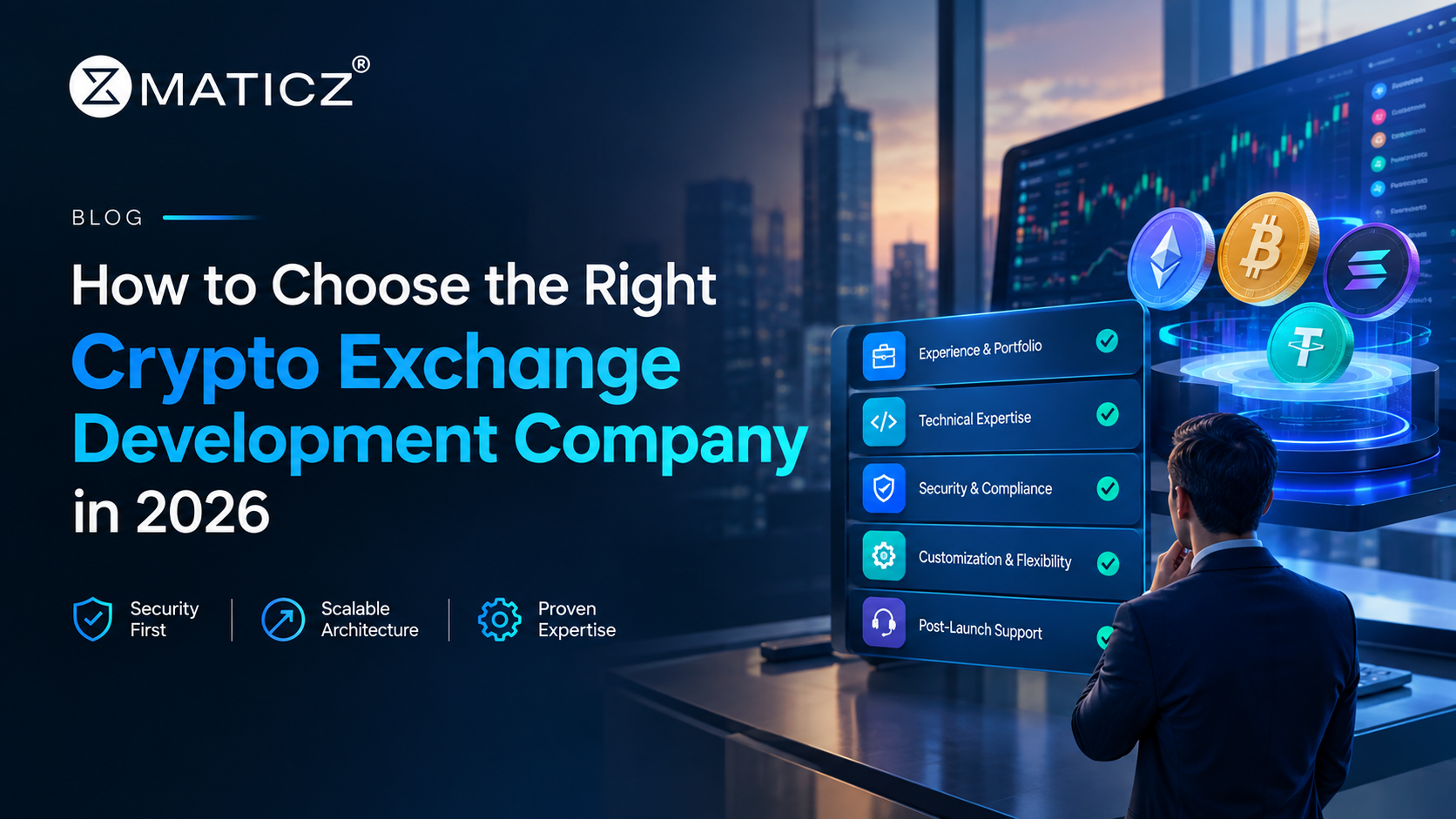
Before selecting a development partner, businesses should review several important factors.
Technical expertise: Check whether the team understands blockchain, trading systems, wallets, APIs, smart contracts, and exchange infrastructure.
Customization: Make sure the company can build around your business model rather than offering only a fixed platform.
Security: Ask about security architecture, testing, wallet protection, access controls, and transaction security.
Integration capability: Confirm whether the team can connect liquidity, KYC, AML, payment, blockchain, and other required services.
Scalability: The platform should be capable of supporting increasing users and trading activity.
Support: Post-launch maintenance and technical assistance are important for a platform that operates continuously.
Comparing companies only by development cost can lead to poor decisions. A better approach is to compare their technical capabilities and overall value.
Businesses can create a simple evaluation checklist covering:
A good development company should also provide a clear scope, development stages, estimated timeline, technology plan, and communication process before development begins.
Maticz provides crypto exchange development services for businesses looking to launch customized digital asset trading platforms. Our team works around the client's business model and develops the required exchange infrastructure based on the selected platform type, features, integrations, and target market.
We can develop centralized, decentralized, P2P, and hybrid exchange solutions with features such as trading engines, secure wallets, liquidity integration, KYC/AML connections, admin dashboards, blockchain integrations, and third-party services.
Our process starts by understanding the business requirements and then planning the architecture, designing the platform, developing the required modules, integrating external services, testing the system, and supporting deployment.
The focus is not simply on launching an exchange quickly. We build the platform with security, customization, scalability, and future business growth in mind.
For businesses that need a tailored solution rather than a basic off-the-shelf platform, our development approach can provide the flexibility needed to create an exchange around their specific objectives.
Launching a crypto exchange in 2026 requires more than an attractive trading interface. Businesses need reliable technology, strong security, liquidity, wallet infrastructure, compliance integrations, scalability, and ongoing technical support.
Choosing the right crypto exchange development company can make the development process more structured and reduce technical risks. Businesses should compare development partners based on experience, customization, security, technology, integrations, scalability, support, and total cost rather than price alone.
With the right planning and development strategy, an exchange can become a scalable digital asset platform that supports users, trading activity, and long-term business growth.
Share Posts
Tap Into the Future
The latest insights, posts, and project updates - straight to your inbox.
Have a Project Idea?
Discuss With Us
✖









Connect With Us