Share Posts




263

854
103
Crypto doesn’t sleep and neither algo bots do. If you’re trading on centralized exchanges in 2026, chances are you’ve come across two popular automation strategies: DCA bots and Grid bots. Both promise disciplined execution and reduced emotional trading, but they serve very different purposes. The real question isn’t which one is better, it’s which one aligns with your capital, risk tolerance, and market outlook.
Let’s simplify this in practical terms.
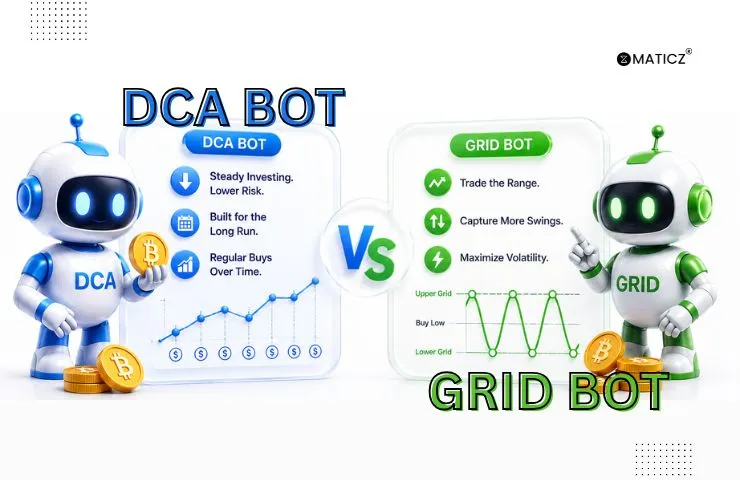
A DCA bot does one simple thing - it buys on a schedule. Every day, every week, or whatever interval you set, it purchases a fixed amount of an asset automatically. It doesn't care if the price is up or down. It just buys. Over time, some of those purchases will be at higher prices and some at lower ones, and your average cost naturally balances out.
A Grid bot works on a completely different idea. Instead of buying over time, it sets up a series of buy and sell orders stacked across a price range. When the price drops to a rung, it buys. When the price climbs back up to the next rung, it sells. Then it waits for the price to fall again and repeats the whole cycle. Every completed round trip earns a small profit.
One is built for patience. The other is built for activity.
The DCA bot is doing something long and slow, building a position brick by brick. The Grid bot is doing something fast and repetitive, making the same small trade over and over, as many times as the market allows.
A DCA bot development is efficient when capital needs to be deployed conservatively. You don’t need to commit everything upfront, and unallocated funds remain available until conditions trigger entries. This makes it suitable for controlled exposure and gradual scaling.
Building a Grid bot requires capital to be pre-allocated across multiple price levels. The wider and more active the grid, the more capital is needed to make the strategy effective. If the grid is underfunded, trade frequency drops and profits get compressed, especially after accounting for fees.
Making it simpler,
Before getting into deeper strategy discussions, it helps to step back and look at how each bot actually handles capital in real conditions. The differences aren’t just technical, they directly impact how funds are deployed, how returns are generated, and where risks show up. Here’s a side-by-side view to make that contrast clear at a glance.
| Factor | DCA Bot | Grid Bot |
| Capital Deployment Style | Gradual, phased allocation over time or price levels | Pre-allocated across multiple price bands |
| Upfront Capital Requirement | Low to moderate | Moderate to high (depends on grid size) |
| Best Use Case | Building positions steadily | Capturing frequent price fluctuations |
| Market Condition Fit | Trending or corrective phases | Sideways / range-bound markets |
| Profit Mechanism | Gains from long-term price appreciation | Small, repeated profits from volatility |
| Risk Exposure | Increasing exposure as more buys are triggered | Risk tied to price moving |
| Capital Efficiency | High for long-term accumulation | High only when volatility stays within range |
| Monitoring Required | Low to moderate | Moderate to high |
| Common Pitfall | Over-allocating in a falling market | Poor grid setup or insufficient capital |
When choosing between these two strategies, the real clarity comes from breaking them down into the factors that actually impact outcomes, how capital is used, how returns are generated, and where things can go wrong.
Capital Deployment
DCA spreads entries over time or price drops, which keeps unused capital on the sidelines until conditions are met. This creates flexibility and reduces timing risk. Grid, in contrast, commits capital upfront across multiple price levels. That capital is always “in play,” but only works efficiently if price keeps moving within the defined range.
Return Generation Logic
DCA depends on eventual price appreciation. The edge comes from lowering the average entry and benefiting when the market recovers or trends upward. Grid generates returns through repetition, buy low, sell slightly higher, over and over. It doesn’t rely on direction, only on consistent price fluctuations.
Market Dependency
DCA aligns with directional bias. It performs better when there’s a clear long-term outlook and temporary dips. Grid is non-directional and performs best in stable, sideways conditions with consistent volatility. A mismatch here is where most inefficiencies come from.
Risk Exposure
With DCA, risk builds as more capital gets deployed into the asset. If the market keeps dropping without recovery, exposure increases. With Grid, risk comes from price escaping the range, leaving capital either stuck in the asset or sitting idle in cash.
Capital Efficiency
DCA is efficient for gradual accumulation but can feel slow in sideways markets. Grid can be highly efficient in the right conditions, generating frequent small gains, but becomes inefficient quickly if volatility drops or price trends strongly.
Operational Involvement
DCA is relatively hands-off once configured. It requires patience more than intervention. Grid demands more attention, ranges need adjustment, and performance depends on how well the setup matches current price behavior.
DCA bot
Reduces timing pressure
Capital is deployed in phases, so there’s no need to perfectly predict entry points.
Supports gradual position building
Works well when the goal is to accumulate over time rather than chase short-term moves.
Handles volatility more smoothly
Price drops become opportunities to average down instead of immediate losses.
Lower capital barrier
Can start with smaller allocations and scale as conditions evolve.
Less operational overhead
Once configured, it doesn’t require constant adjustments or monitoring.
Grid Bot
Monetizes sideways movement
Generates returns even when the market lacks a clear direction.
Creates frequent trading opportunities
Multiple buy/sell levels allow continuous execution within a range.
Structured profit-taking
Gains are captured automatically at predefined intervals, reducing hesitation.
Maximizes active capital usage
Allocated funds are continuously engaged across the grid levels.
Works well in stable volatility
Performs consistently when price oscillates within predictable boundaries.
If your approach is centered on steady deployment and long-term positioning, DCA strategies remain the more practical fit. They allow capital to be introduced gradually, reduce exposure to poor timing, and align well with markets that move in cycles rather than clean ranges. This makes them particularly suitable when consistency and controlled allocation matter more than frequent trade execution.
On the other hand, if your capital is set aside specifically for active utilization and you’re aiming to capture short-term price movements, Grid strategies offer a more dynamic path. They perform best when there’s enough liquidity to distribute across levels and when market conditions support repeated price swings. However, this approach demands closer oversight and a clearer understanding of market structure.
In reality, 2026 isn’t about choosing one over the other, it’s about segmenting capital based on purpose. A portion can be allocated for gradual accumulation using DCA, while another can be assigned to Grid strategies to take advantage of range-bound opportunities. This layered approach allows for both stability and activity within the same portfolio.
For businesses looking to implement these strategies at scale, crypto algo trading platform has become a critical focus area. Maticz builds customizable DCA and Grid bot solutions that support both strategies within a single system — covering automation, capital allocation, and performance tracking across centralized exchanges.
Share Posts
Tap Into the Future
The latest insights, posts, and project updates - straight to your inbox.

GnanaPrakash Balakrishnan

As the CEO & Co-Founder of Maticz, Gnanaprakash Balakrishnan is a visionary leader dedicated to moving AI and Web3 beyond industry buzzwords to solve real-world problems. He believes that true innovation stems from a "people-first" culture, where trusting and supporting bold thinkers is the key to turning experimental code into meaningful digital experiences.

FAQ
Connect with our experts for detailed technical consultation.

A DCA bot deploys capital gradually over time or at price drops, building a position without requiring upfront commitment. A Grid bot pre-allocates capital across multiple price levels and profits from repeated buy-sell cycles within a defined range.
DCA bots are generally more suitable for beginners. They require less monitoring, have a lower capital barrier, and are easier to configure. Grid bots demand more active oversight and a clearer understanding of market structure to set up effectively.
Grid bots require moderate to high capital depending on the grid size and price range. Underfunding a grid compresses trade frequency and reduces profitability, especially after accounting for exchange fees.
Yes. Many traders segment their capital — allocating one portion for gradual accumulation via DCA and another for active cycling via Grid. This layered approach balances stability with short-term opportunity capture.
DCA bots underperform in sideways or range-bound markets where price doesn't trend upward over time. In those conditions, capital keeps getting deployed without meaningful price appreciation to generate returns.
Grid bots underperform when price breaks out of the defined range — either trending strongly upward or crashing downward. In trending markets, the bot either misses gains or accumulates a losing position.
Grid bots perform best in sideways, range-bound markets with consistent volatility. Stable price oscillation within a defined band allows the bot to complete more buy-sell cycles and generate frequent small profits.
Yes. Both strategies are commonly supported on centralized exchanges (CEX) and can be implemented through custom-built trading bots that integrate with exchange APIs for automated execution.

Have a Project Idea?
Discuss With Us
✖









Connect With Us