Share Posts




46

620
103
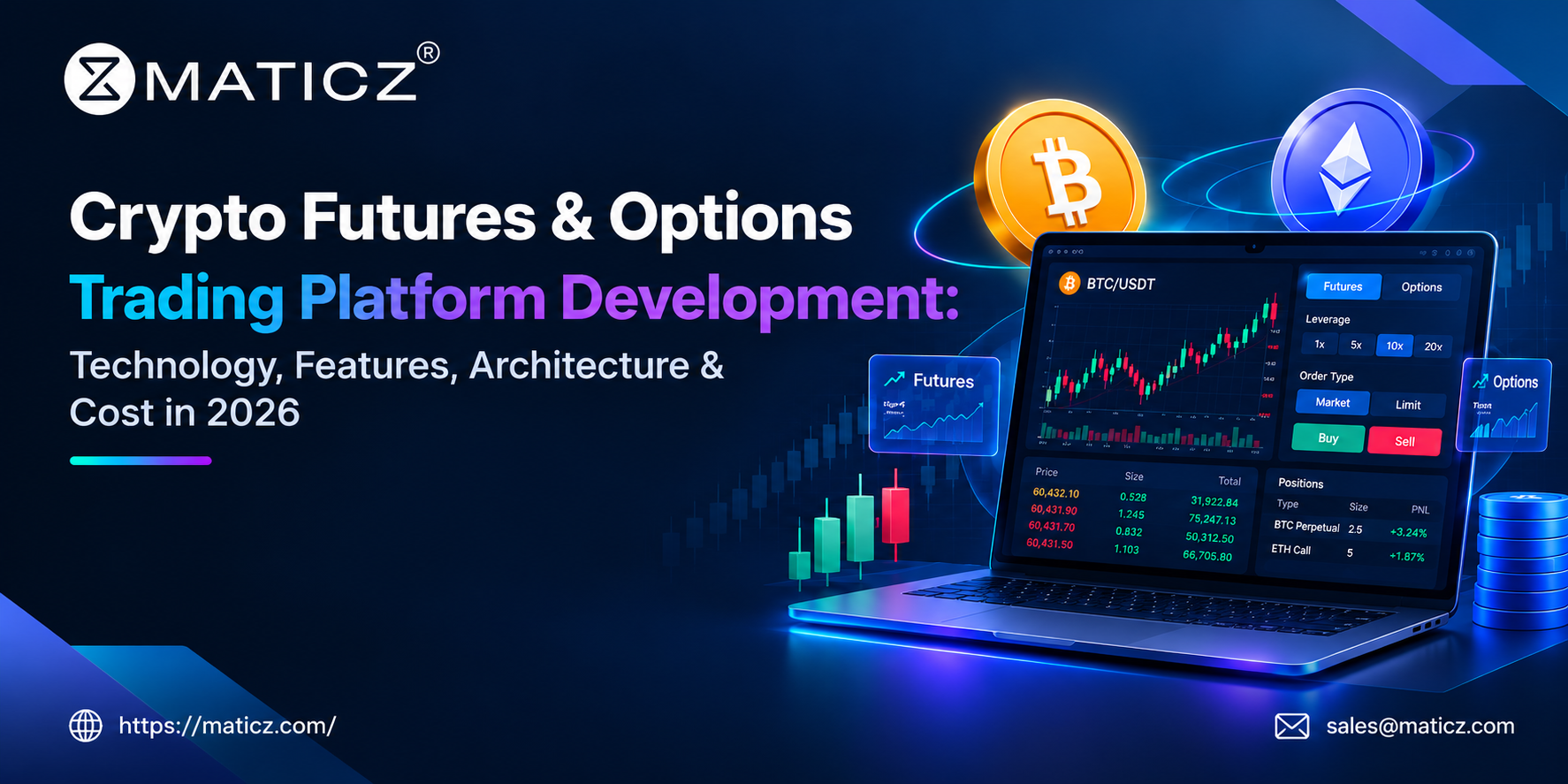
Crypto derivatives have become an important part of digital-asset markets in 2026. Institutional traders, professional investors, brokers, and fintech businesses increasingly use futures, perpetual contracts, and options for leverage, hedging, market-neutral strategies, and advanced portfolio management. This has increased demand for Crypto Futures & Options Trading Platform Development beyond conventional spot exchange infrastructure. A derivatives platform must manage leveraged positions, collateral, margin requirements, funding rates, liquidation risk, options pricing, and real-time market data while maintaining fast and reliable execution. For businesses, building the trading interface is only one part of the project. The core infrastructure must include a high-performance matching engine, risk engine, liquidation system, margin calculation layer, price-oracle infrastructure, custody integration, market surveillance, and administrative controls. At Maticz, we design derivatives platforms around the business model, target market, regulatory requirements, liquidity strategy, and expected trading volume rather than treating the exchange as a standard software package. A crypto futures and options platform is a specialized trading system that allows users to trade derivative contracts based on digital assets. Unlike spot trading, where users directly buy or sell an asset, derivatives allow traders to gain exposure to an asset through a contract. Traders can take long or short positions and use leverage depending on the platform's margin rules. Futures contracts create an obligation to buy or sell an underlying asset at a specified price. They can include: Perpetual futures with no fixed expiry Monthly futures Quarterly futures Linear contracts settled in stablecoins Inverse contracts settled in cryptocurrency Options give the buyer the right, but not the obligation, to buy or sell an underlying asset at a predetermined strike price. The primary categories are: Call options Put options European-style options American-style options Multi-leg options strategies For example, a trader could use a BTC call option to gain upside exposure while limiting the maximum loss to the premium paid. A modern crypto derivatives platform can support multiple contract types under one powerful trading infrastructure. Perpetual futures are among the most actively used crypto derivatives because they have no fixed expiration date. A perpetual futures platform generally requires: Funding-rate calculation Mark-price calculation Index-price aggregation Initial and maintenance margin Position management Partial liquidation Insurance fund Auto-deleveraging Linear and inverse contract support Funding mechanisms help keep perpetual contract prices aligned with the underlying market. Fixed-maturity futures have defined settlement dates, such as monthly or quarterly expiries. The platform must automatically manage: Contract creation Expiry schedules Settlement prices Open-interest tracking Margin requirements Position expiry Settlement calculations Historical contract data An automated settlement engine reduces manual intervention when contracts expire. Crypto options require more infrastructure than basic futures trading because the platform must manage strike prices, premiums, expiration dates, implied volatility, and option Greeks. A platform can support: Call and put options European options American options Multiple strike prices Multiple expiration dates Multi-leg strategies Options order books Volatility trading Common strategies include: Straddles Strangles Spreads Covered calls Cash-secured puts A reliable derivatives platform requires several interconnected infrastructure layers. The matching engine is the core component responsible for processing buy and sell orders. For institutional applications, the engine should be designed around: Low-latency order processing Deterministic matching Price-time priority Memory-first execution High concurrent order throughput Order validation Cancel/replace processing Market data publishing Fault recovery C++, Rust, and Go can all be suitable choices depending on the architecture and engineering requirements. For a high-frequency crypto trading engine, performance should be benchmarked using realistic workloads rather than relying only on theoretical TPS figures. A specialized architecture can be designed to target 100,000+ order operations per second where the infrastructure and workload justify that capacity. For hybrid or decentralized architectures, the blockchain layer handles selected settlement, custody, collateral, or trading functions. Depending on the business model, we can integrate: EVM-compatible networks Non-EVM networks Layer-2 networks App-specific chains State-channel architectures Smart-contract-based settlement A centralized matching engine can also be combined with on-chain settlement to create a hybrid derivatives architecture. The backend coordinates trading, accounts, balances, positions, risk, notifications, and administrative services. A typical architecture may include: Go or Node.js microservices Kafka or RabbitMQ Redis PostgreSQL TimescaleDB REST APIs WebSocket services FIX connectivity for institutional participants Different services can be separated for orders, positions, risk, wallet operations, market data, and reporting. The trading interface must display rapidly changing market information without creating unnecessary latency. A modern interface can include: React or Next.js React Native for mobile applications TradingView charting Real-time WebSocket feeds Order-book visualization Position dashboards Margin indicators P&L calculations Funding-rate information Liquidation-price displays Institutional derivatives platforms require infrastructure designed for availability, security, and controlled access. Possible components include: Institutional custody integrations MPC-based custody Fireblocks integrations HSM-backed key management Multi-factor authentication Role-based access control DDoS protection WAF Network segmentation AWS or GCP infrastructure Dedicated or bare-metal servers for latency-sensitive components A derivatives exchange needs an order engine capable of handling large numbers of concurrent orders. Important capabilities include: Sub-millisecond processing targets where infrastructure permits Deterministic execution Price-time priority High-throughput order processing Market-data broadcasting Order validation Fault recovery For institutional clients, the matching engine should be benchmarked under realistic peak loads before production deployment. The risk engine continuously evaluates user positions and available collateral. It can manage: Initial margin Maintenance margin Unrealized P&L Realized P&L Position exposure Liquidation thresholds Partial liquidation Insurance-fund interaction Auto-deleveraging Partial liquidation can help reduce a position gradually instead of immediately closing the entire exposure, depending on the platform's risk policy. A platform can support: Isolated Margin Only the allocated collateral is exposed to the individual position. Cross Margin Eligible account collateral can support multiple positions. Portfolio Margin Margin requirements are calculated based on the combined risk of multiple positions and assets. Portfolio margin requires a more advanced risk model because correlations, offsets, stress scenarios, and portfolio exposure must be evaluated. The administration layer provides operational control over the entire exchange. It can include: User management KYC status Position monitoring Margin monitoring Liquidation monitoring Asset management Contract configuration Fee configuration Leverage controls Risk limits Market surveillance Trading-pair management Liquidity monitoring Audit logs Regulatory reports The first stage defines the business model and regulatory scope. We evaluate: Target jurisdictions Customer types Derivative products Leverage limits Custody model KYC/AML requirements Liquidity strategy Centralized or hybrid architecture Legal counsel should determine the applicable licensing and regulatory requirements in each target market. The next step defines the technical architecture. This includes: Order protocol Matching logic Margin model Position model Contract specifications Settlement mechanism Market-data architecture API design The core trading infrastructure is then developed. Our engineering team can build: Matching engine Risk engine Margin calculator Liquidation engine Funding engine Settlement engine Insurance-fund module ADL mechanism These systems should be load-tested independently and together. The trading interface is developed around the selected contract types. Key screens generally include: Markets Trading terminal Order book Charts Positions Open orders Order history Wallet Margin information P&L Risk notifications Liquidity is critical for a new derivatives exchange. We can integrate external liquidity providers and market makers through: FIX REST WebSocket Institutional APIs Liquidity can also be distributed across multiple venues depending on the business strategy. Before launch, the platform should undergo extensive testing. This includes: Smart contract audits API security testing Penetration testing Load testing Stress testing Failover testing Database recovery testing Wallet security testing Liquidation testing Oracle failure testing The final stage covers production deployment and launch preparation. It includes: Infrastructure deployment Monitoring Liquidity configuration Market-maker onboarding Production security controls Backup systems Incident response Performance monitoring Continuous upgrades The Crypto derivatives platform development cost depends heavily on the number of products, performance requirements, risk models, liquidity integrations, regulatory scope, and security architecture. These are indicative development ranges. A final estimate requires technical discovery and scope definition. Advanced analytics and automated algorithms are increasingly being integrated into derivatives infrastructure. Predictive models can analyze: Account equity Position exposure Market volatility Funding rates Historical liquidation patterns Price movements This can help risk teams identify accounts approaching critical risk levels. These models should support, rather than replace, deterministic liquidation rules. Options platforms can use statistical and machine-learning models to analyze market volatility. Potential applications include: Volatility forecasting Implied-volatility monitoring Options pricing support Risk scenario generation Portfolio stress analysis Market makers can connect trading algorithms through APIs to continuously provide bids and asks. The infrastructure can support: Market-making bots Arbitrage systems Grid strategies Delta-neutral strategies Hedging algorithms Automated monitoring can analyze large volumes of trading activity to identify unusual behavior. Examples include: Abnormal order patterns Coordinated trading Account anomalies Suspicious withdrawals Unusual position accumulation Potential wash trading The important consideration is to keep these systems connected to clear human review and operational controls. Businesses can choose different architecture models depending on their requirements. For high-volume institutional markets, a hybrid architecture can be considered when businesses want centralized matching performance while using blockchain infrastructure for selected settlement or collateral functions. Building a derivatives platform requires more than connecting an existing trading interface to a database. The matching, risk, margin, liquidation, settlement, custody, and market-data systems must work together under high trading loads. At Maticz technologies, we approach derivatives exchange engineering from both the business and infrastructure perspectives. Our capabilities include: Custom matching-engine architecture Futures and perpetual trading infrastructure Crypto options exchange development Portfolio and cross-margin systems Automated liquidation engines Insurance-fund and ADL mechanisms Liquidity-provider integration Institutional custody integration Market-data and oracle integration Advanced trading interfaces Security audits and penetration testing Scalable cloud and dedicated infrastructure Admin and risk-control systems Compliance-oriented architecture We also help businesses structure their liquidity strategy, connect institutional LPs and market makers, and design infrastructure that can scale as trading activity increases. The right platform architecture depends on your target market, supported contracts, expected trading volume, margin model, liquidity requirements, and regulatory framework. If you are planning to launch a futures, perpetuals, or options business, Maticz can help you design and engineer the complete derivatives trading infrastructure around your business requirements. Contact the Maticz technical team for a customized platform demo, architecture discussion, and project consultation.What Is a Crypto Futures & Options Trading Platform?
Futures
Options
Types of Derivatives Supported in Platform Development
Perpetual Futures
Fixed-Maturity Futures
Crypto Options
Futures vs Options: Key Differences
Core Technical Architecture for a High-Performance Derivatives Platform
1. Matching Engine
2. Smart Contract and Blockchain Layer
3. Backend and Microservices
4. Frontend and Mobile Trading Layer
5. Security and Infrastructure
Key Infrastructure Features Required for Success
Institutional Order Matching Engine
Multi-Tier Risk Engine and Auto-Liquidation
Dynamic Margin System
Different traders may require different margin models.
Admin and Risk Management Control Center
Step-by-Step Development Process
1. Business Architecture and License Planning
2. Engine Architecture and Protocol Design
3. Matching Engine and Risk Layer Engineering
4. Frontend and Charting Integration
5. Liquidity Aggregation and Market Maker Connectivity
6. Security Audit, Load Testing and Penetration Testing
7. Deployment, Liquidity Seeding and Maintenance
Crypto Derivatives Platform Development Cost in 2026
Development Cost and Timeline
How AI and High-Frequency Algorithms Are Transforming Crypto Derivatives in 2026
Automated Liquidation Risk Prediction
Volatility Modeling
Algorithmic Market Making
Fraud and Anomaly Detection
Centralized vs Hybrid Crypto Derivatives Architecture
Why Choose Maticz for Crypto Futures & Options Trading Platform Development?
Share Posts
Tap Into the Future
The latest insights, posts, and project updates - straight to your inbox.

Have a Project Idea?
Discuss With Us
✖









Connect With Us