Share Posts




46

631
103
A crypto exchange can attract users through spot trading, but some traders eventually look for more ways to manage price movements, use leverage, or trade contracts linked to future prices. For exchange businesses, adding derivatives can open a new growth path without requiring them to build an entirely separate trading platform from scratch.
However, expanding an existing exchange requires more than adding futures and options to the trading screen. The business must support margin calculations, position tracking, liquidation, liquidity management, risk controls, and reliable order execution. A well-planned Cryptocurrency Exchange Development strategy helps connect these components with the exchange's existing trading infrastructure while protecting the stability of its spot market.
This guide explains how businesses can introduce derivatives trading to an existing crypto exchange in 2026, including the required technology, essential features, development steps, security measures, costs, and common mistakes to avoid.
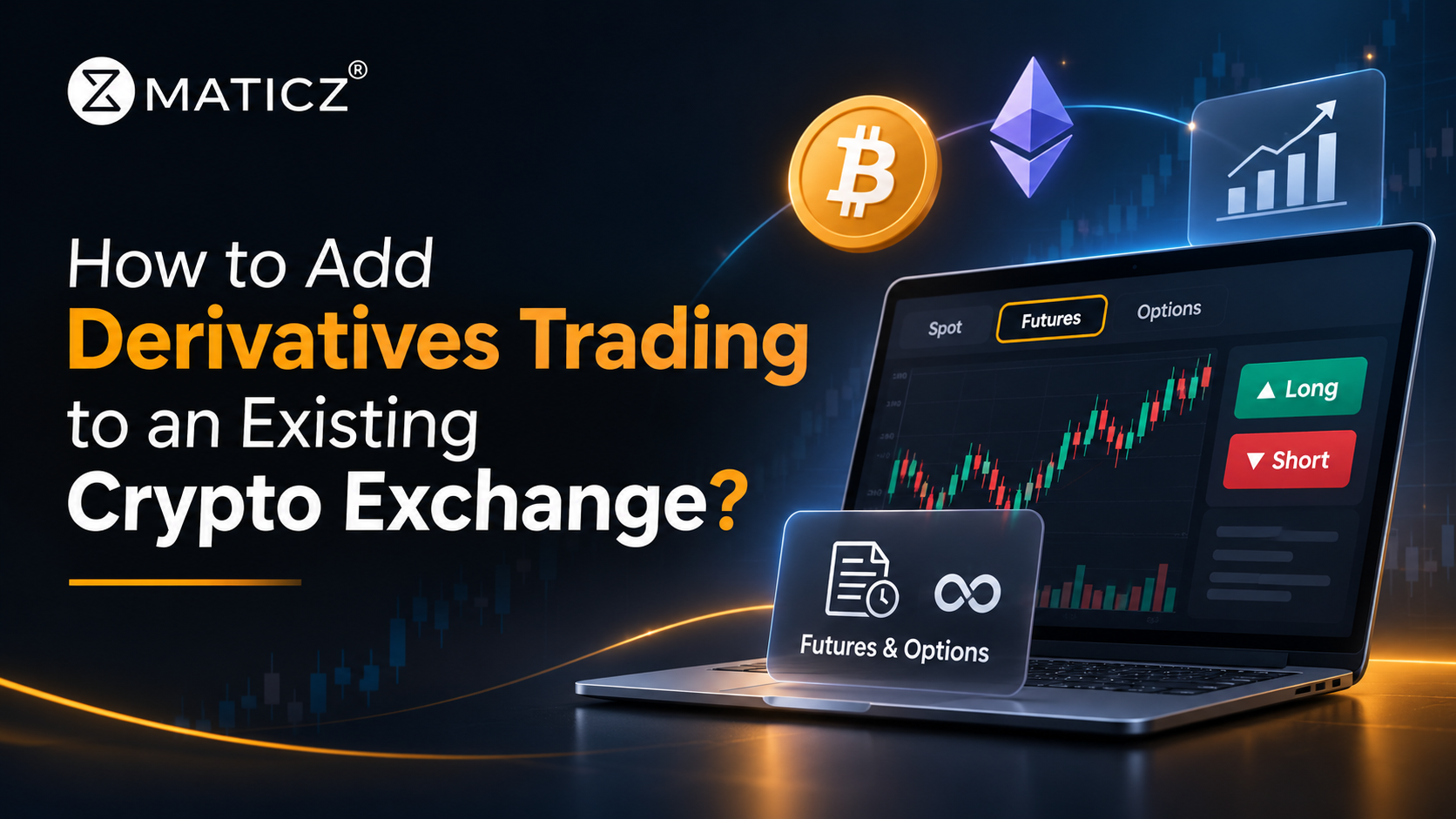
Adding derivatives trading means expanding an existing exchange to support financial contracts whose value depends on an underlying asset, such as Bitcoin or Ethereum.
Unlike spot trading, where users buy or sell the actual cryptocurrency, derivatives allow traders to take positions based on price movements without necessarily owning the underlying asset.
For example, a trader who expects Bitcoin's price to rise could open a futures position. Another trader who expects the price to fall could take a short position, depending on the contract and exchange rules.
An existing exchange can introduce several types of derivatives:
Futures contracts: Agreements to buy or sell an asset at a specified price under defined contract terms.
Perpetual contracts: Derivatives without a fixed expiry date, often using funding payments to help keep contract prices aligned with the underlying market.
Options contracts: Contracts that give buyers the right, but not the obligation, to buy or sell an asset at a specified price within defined terms.
Each product requires different pricing rules, margin calculations, and risk controls. Therefore, businesses should decide which contracts to support before beginning development.
Spot trading remains an important part of a crypto exchange, but it does not meet every trader's requirements. Derivatives can help an exchange serve a wider range of users, from active retail traders to professional trading firms.
Experienced traders may want futures, perpetual contracts, or options alongside their existing spot positions. Offering these products within the same account environment can make an exchange more useful to customers with different trading strategies.
A derivatives market can generate revenue through trading fees, funding-related services where applicable, and other permitted platform services. Actual revenue depends on trading activity, fee structures, competition, and operating costs.
Businesses and traders holding cryptocurrency may use derivatives to manage exposure to price changes. For example, a company holding Bitcoin could use an appropriate futures position to reduce some of its downside exposure.
When users can manage spot holdings and derivatives positions within one platform, they may have fewer reasons to move between multiple exchanges. This can support retention, provided the platform delivers a dependable trading experience.
The important point is that derivatives should address a real customer need. Adding complex products without sufficient demand, liquidity, or risk management can create more operational problems than business value.
A spot exchange cannot simply reuse every part of its existing system without modification. Some components can be shared, while others need separate logic designed for leveraged positions and contract-based trading.
The matching engine processes buy and sell orders according to the exchange's matching rules. Derivatives introduce additional requirements, including contract-specific order validation, position updates, margin checks, and risk-related order restrictions.
The exchange must also manage order cancellations, partial fills, rejected orders, and high trading volumes without creating inconsistencies between orders and positions.
Margin is the collateral a trader must maintain to open or support a leveraged position.
The platform needs to calculate initial margin, which is required to open a position, and maintenance margin, which is the minimum amount required to keep it open under the applicable rules.
For example, if a trader opens a position worth $10,000 using 5x leverage, the initial margin might be approximately $2,000 under a simplified model. Actual requirements depend on the exchange's margin rules, fees, risk limits, and contract specifications.
The exchange must track each position's size, entry price, current valuation, unrealized profit or loss, realized profit or loss, and available margin.
These figures should update consistently as orders execute and market prices change. Delayed or incorrect calculations can lead to inaccurate risk assessments and unexpected liquidations.
Derivatives depend on reliable market pricing. Depending on the contract, the platform may need last-traded prices, index prices, mark prices, and funding-rate calculations.
The mark price is particularly important because it can be used to calculate unrealized profit and loss and determine whether a position is approaching liquidation. The exchange should design safeguards against faulty data, stale prices, and abnormal market movements.
A derivatives platform needs more than a futures trading button. Its features must support the complete journey from placing an order to closing a position.
Administrators should be able to configure supported trading pairs, contract specifications, tick sizes, quantity limits, leverage limits, settlement methods, and expiry dates where applicable.
These settings must be controlled carefully because contract changes can affect open positions and active orders.
The platform should support configurable leverage, initial and maintenance margin calculations, collateral valuation, and margin alerts.
It should also enforce position limits and account-level risk restrictions. Higher leverage can increase trading exposure, but it also increases the speed at which losses can consume a trader's collateral.
When an account no longer meets its applicable margin requirements, the exchange may need to reduce or close positions under its liquidation rules.
The liquidation engine should monitor account risk continuously, calculate liquidation conditions, cancel relevant orders when required, and execute risk-reduction actions according to predefined rules.
Businesses should also define what happens when a position cannot be closed at a suitable price or an account's losses exceed its available collateral.
Perpetual contracts commonly use funding payments between long and short positions, according to the exchange's funding mechanism. Dated futures and options may require expiry, settlement, or exercise procedures.
The platform must calculate these amounts accurately, record account adjustments, and provide users with a clear transaction history.
Users should be able to view open positions, margin ratios, liquidation prices, unrealized profit and loss, order history, funding payments, and available collateral.
Clear warnings can help users understand changing risk levels. The interface should make essential information easy to find without overwhelming beginners with technical details.
A phased development approach allows businesses to extend their existing platform while keeping technical and operational risks under control.
Begin by reviewing the current exchange architecture, including its matching engine, account system, wallets, market data, APIs, security controls, and database structure.
Identify which components can support derivatives and which require modification or replacement.
This assessment should also consider current trading volume, expected order throughput, infrastructure capacity, and the potential impact on spot trading. The objective is to avoid introducing derivatives in a way that weakens the existing service.
Choose the product that best matches the business model and target users.
An exchange might begin with selected perpetual contracts, introduce dated futures, or develop options trading when there is sufficient demand and technical capacity.
Define the supported markets, collateral assets, leverage limits, settlement rules, and user eligibility requirements. A focused initial release is generally easier to test and manage than launching every product simultaneously.
Plan how orders, positions, collateral, market prices, and risk calculations will interact.
The architecture should define which components can be shared with spot trading and which should operate independently. For example, the exchange may reuse identity verification and wallet infrastructure while introducing a dedicated derivatives risk engine.
Real-time processing is especially important for margin checks and liquidations. The system should also maintain consistent records when several orders execute rapidly or a market experiences heavy volatility.
Develop the calculations that determine available margin, position exposure, unrealized profit and loss, and liquidation thresholds.
Test different scenarios, including sudden price drops, sharp price increases, partial liquidations, insufficient collateral, and simultaneous position changes.
Risk controls should be established before opening the market to real users. A visually complete trading interface is not evidence that the underlying risk engine is ready.
A derivatives market needs reliable pricing and sufficient trading activity for users to enter and exit positions.
Businesses may explore market-maker partnerships, liquidity providers, or other permitted liquidity arrangements. They should also assess order-book depth, spreads, execution quality, and the ability to manage large orders.
External market data should be validated before it influences margin calculations or liquidation decisions. Backup feeds and clear procedures for data interruptions can help reduce operational risks.
Review the legal and regulatory requirements for offering derivatives in each intended market before launch. Requirements can differ significantly by jurisdiction, customer type, and product.
Depending on the business model, the platform may need identity verification, sanctions screening, transaction monitoring, user eligibility controls, trading restrictions, and regulatory reporting.
Security work should cover account protection, administrative permissions, wallet infrastructure, API authentication, withdrawal controls, data protection, and monitoring of unusual activity.
Testing should cover more than ordinary order placement.
The exchange should validate matching accuracy, margin calculations, liquidation behaviour, funding payments, settlement, system recovery, and the consistency of account balances.
Load testing should simulate high order volumes and volatile markets. Security assessments should examine both smart contract components, where used, and the exchange's off-chain systems.
A controlled pilot or staged rollout can reveal operational issues before the product becomes available to a broader user base.
After launch, monitor order latency, failed transactions, market depth, margin events, liquidation frequency, system availability, and customer support issues.
Risk parameters may require adjustments as trading behaviour and market conditions change. Changes should follow documented approval and testing procedures rather than being made casually during volatile periods.
The exchange should also collect feedback from users and market participants to determine which improvements will provide the most value.
Liquidity and risk management need special attention because leveraged trading can amplify the effect of market movements.
Thin order books can cause large price movements when traders place substantial orders. Wider spreads and slippage can also make it difficult to close positions during volatile periods.
Exchanges should assess liquidity requirements for each contract and establish realistic market-making arrangements. They should monitor liquidity during both normal trading and stressed market conditions.
The platform should apply leverage limits, position limits, collateral haircuts where appropriate, and account-level exposure controls.
Risk parameters should reflect the volatility and liquidity of each market. A highly volatile trading pair may require stricter limits than a deeper, more established market.
Liquidation procedures should reduce exposure when margin requirements are breached. Depending on the exchange's design, an insurance fund may help cover certain deficits that remain after liquidation.
Some platforms may also use auto-deleveraging or other defined loss-management mechanisms. These systems must be clearly documented, tested, and explained to users because they can affect positions during extreme market conditions.
A derivatives exchange should have procedures for market-data interruptions, matching-engine failures, network disruptions, and unexpected spikes in trading activity.
Monitoring, incident response, disaster recovery, and reliable transaction records help the business maintain control when normal operating conditions change.
Security and compliance must be part of the original design rather than final checks added before launch.
Important areas include:
Account security: Strong authentication, session controls, and protection against account takeover.
API security: Authentication, permission limits, rate limiting, and secure API-key management.
Data protection: Encryption, controlled access to sensitive information, and secure storage practices.
Operational security: Role-based permissions, audit logs, infrastructure monitoring, and incident response.
Trading safeguards: Price-band checks, order limits, market-data validation, and protections against abnormal system behaviour.
Regulatory readiness: Appropriate licensing or authorization, customer eligibility checks, disclosures, and reporting based on applicable rules.
Businesses should obtain qualified legal advice before offering derivatives in a new jurisdiction. A platform's technical ability to accept users does not mean that offering the product to those users is legally permitted.
Reusing spot-trading logic without proper changes: Spot balances and derivatives collateral serve different purposes. The account model must reflect margin requirements and unrealized losses.
Launching with insufficient risk controls: Margin calculations, liquidation procedures, and exposure limits must be tested before real trading begins.
Treating liquidity as a later task: A technically functional market can still deliver poor execution if order-book depth and liquidity arrangements are inadequate.
Offering excessive leverage: High leverage can increase liquidation risk and expose the platform to more difficult market conditions.
Ignoring jurisdiction-specific requirements: Derivatives rules can differ from those governing ordinary spot trading. Compliance planning must reflect the actual products and customer locations.
Launching every contract at once: A smaller, well-tested initial market can help the exchange validate its infrastructure before adding more products.
Avoiding these mistakes helps businesses focus on building a reliable derivatives service rather than simply expanding the exchange's feature list.
Both types of markets can share parts of an exchange's infrastructure, but derivatives require additional systems to manage leveraged positions and contract-specific risks.
Maticz Technologies can support businesses looking to extend an existing crypto exchange with derivatives functionality. The development scope can include trading-engine enhancements, futures and perpetual contract modules, margin management, liquidation mechanisms, liquidity integrations, trading interfaces, and security-focused infrastructure.
The right approach depends on the exchange's current architecture, target users, selected products, and operating jurisdictions. Rather than treating derivatives as an isolated feature, businesses should plan how the new market will work with existing accounts, wallets, market data, and operational processes.
A structured implementation can help an exchange introduce new trading capabilities while maintaining a clear focus on performance, reliability, security, and risk management.
Adding derivatives changes more than the products displayed on an exchange. It introduces a new set of responsibilities around collateral, leverage, pricing, liquidations, liquidity, and continuous risk monitoring.
In 2026, exchanges planning this expansion should focus on building infrastructure that can handle these responsibilities under both normal and stressed market conditions. The goal is not simply to offer more contracts, but to deliver a trading environment that users can understand and that operators can manage responsibly.
Businesses that plan the architecture carefully, validate market demand, and establish effective controls before launch can create a stronger foundation for future product expansion.
Adding derivatives trading to an existing crypto exchange requires coordinated changes across trading infrastructure, margin management, liquidity, settlement, security, and compliance. The process begins with assessing the current platform, selecting suitable contracts, and designing the systems needed to manage positions and risk.
A successful expansion also depends on realistic testing, reliable market data, appropriate leverage controls, and ongoing monitoring after launch. These elements help businesses build a derivatives market that fits their operational capabilities and customer requirements.
With a well-planned Cryptocurrency Exchange Development approach, Maticz Technologies can help businesses explore the technical requirements of expanding an existing exchange into futures, perpetuals, and other derivatives products, with the architecture tailored to their business model and long-term goals.
Share Posts
Tap Into the Future
The latest insights, posts, and project updates - straight to your inbox.

Have a Project Idea?
Discuss With Us
✖









Connect With Us